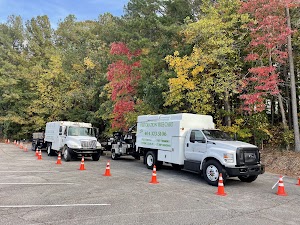
Tree Removal Service That Follows the City’s Permit Rules
Woodstock protects its trees more closely than most cities in north metro Atlanta. Inside city limits, almost every tree removal needs a permit, including small trees and dead ones, and the city tracks its canopy closely. A Georgia Forestry Commission assessment in March 2024 put the city’s tree canopy at 41%. If you have a pine leaning toward the house or an oak dropping limbs over the driveway, you need a tree removal service that checks the permit question before the crew shows up.
Restoration Tree Care is a family-owned, insured tree company. We handle removal of dead, leaning and unwanted trees for homeowners, HOAs and property managers, and our own crew does the work from the estimate to the cleanup.
Permits Inside City Limits
According to the city’s Tree Preservation page:
- A permit is required to remove any tree over 3 inches in caliper.
- Tree removal permits are free.
- On a residential lot, up to five trees that aren’t specimen trees can be removed in a calendar year with that no fee permit.
- Dead and dying trees still need an approved permit before they come down.
- Work done without a permit is fined for every inch cut, with a higher rate for specimen trees.
Because the fines are charged by the inch, cutting first and asking later gets expensive fast on a large tree. We check the permit status before any work is scheduled.
Is It a Specimen Tree?
Specimen trees get extra protection based on size, species and condition. By the city’s standards, a tree can qualify at:
- 24 inches or more for oak, beech, ash, blackgum, sycamore, hickory, most maples, pecan, walnut, most magnolias, persimmon, sourwood, cedar, cypress and redwood
- 30 inches or more for tulip poplar, sweetgum, river birch, silver maple and pine
- 10 inches or more for American holly, dogwood and redbud
Size alone isn’t enough. A specimen tree also has to be in good shape, with a life expectancy of more than 15 years, a sound trunk and only limited dead wood. That means a large tree in poor condition may not count as a specimen at all, which can change what the removal involves.
Replanting After a Removal
The same 2024 assessment found about 540 acres of potential planting area in the city, room for many thousands more trees. If you’re taking down a tree that grew too close to the house, it’s worth thinking about where a replacement could go. A large canopy tree planted well away from the roof and the lines gives you shade later without the same risk. Once the stump is ground, the spot is ready for new planting, and we’re happy to talk through placement while we’re on site.
When Pruning Is the Better Call
With rules this strict, it’s worth asking whether the tree really has to go. Our arborist services can tell you whether pruning or trimming would solve the problem, such as clearing limbs off the roof or thinning a heavy crown. If the tree can stay, we’ll say so.
On the Day of the Removal
Once the permit is in hand, a climber takes the tree apart from the top down and the crew lowers each section on ropes so nothing lands on the house, fence or neighbor’s yard. If there’s no safe way to climb or reach the tree, a crane may be used. We chip the brush, haul away the wood and rake the yard. Stump grinding happens during the same appointment if you want the stump gone.
Storm Damage
When a storm puts a tree on your roof, car or driveway, call us. Our emergency crews respond around the clock and start by getting the weight off the structure. If a tree is touching a power line, stay back and call the utility first.
Once everyone is safe, look at what’s still standing. Trees that were cracked or partly uprooted but aren’t an immediate danger still go through the city’s permit process, even if they’re dying. Take clear photos of the damage from a few angles right after the storm, since they show the tree’s condition and make the request easier to put together.
Serving Cherokee and Cobb Counties
We’re a full tree service working across north metro Atlanta, including Kennesaw, Acworth and Roswell. Read what homeowners say on our reviews page, or learn more about our team.
Questions About the City’s Tree Rules
Do I really need a permit for a small tree?
Inside city limits, yes, if it’s over 3 inches in caliper. That covers most trees beyond the sapling stage.
How much does a removal permit cost?
Nothing. The city’s permits are free. The cost comes from skipping one, since fines are charged per inch of trunk cut.
Does the five tree limit reset every year?
Yes. On a residential lot, up to five trees that aren’t specimen trees can be removed in a single calendar year under the no fee permit.
Is my big oak or pine a specimen tree?
It may be. Oaks qualify at 24 inches and pines at 30 inches, but only if the tree is also in good condition with a life expectancy of more than 15 years. We’ll measure it and look at its condition during the estimate.
My address says Woodstock, but I’m outside city limits. Do these rules apply?
Not necessarily. Some homes with a Woodstock mailing address are in unincorporated Cherokee County, where county rules apply instead. We’ll check which rules cover your property before work starts.
Get a Free Estimate
If a tree on your property is leaning, dying or hanging over the house, have it looked at before the next storm. Contact us today or call (470) 276-0495 to request a free estimate for tree removal service in Woodstock, GA.